About The Event
Organized by Faculty of Public Health Sciences
James Lind Institute, Geneva, Switzerland
Date: 2nd August, 2025 and 7th August, 2025
Venue: Virtual Platform – Zoom
Introduction to the Event
The theme for the World Breastfeeding Week 2025 is: “Prioritise Breastfeeding: Create Sustainable Support Systems.” The theme emphasizes the importance of strong support networks that allow women to successfully breastfeed. It emphasizes the necessity of fostering breastfeeding-friendly surroundings at home and in the workplace. This consists of programs like paid maternity leave, breastfeeding breaks, and access to low-cost childcare.
World Breastfeeding Week (WBW) 2025 took place globally from August 1 to August 7, 2025. The World Health Organization (WHO), UNICEF, and a number of health ministries and civil society organizations support this yearly event. It aims to create awareness about the necessity of breastfeeding and promote the advantages of exclusive breastfeeding for newborns.
So, as part of this campaign, we want to Support every step of the journey, Train and empower health workers and Create breastfeeding-friendly health systems.
Topics covered in the panel discussion
- Breastfeeding benefits both infants (immune system, cognitive development) and moms (lower chance of breast cancer, maternal health), long-term societal benefits, including lower healthcare expenditures and healthier generations
- Cultural behaviors and beliefs about breastfeeding need to be addressed
- Creating supportive environments for nursing: the significance of family support in nursing success
- Breastfeeding in the workplace: overcoming barriers for working mothers
- Global challenges of breastfeeding: addressing disparities in low-resource settings
- Initiatives and policies to improve global breastfeeding rates by Organizations such as UNICEF and WHO
- Sustainable practices – discussing the theme
Objectives:
- Raise awareness about the benefits of breastfeeding.
- Discuss the current issues and support systems for breastfeeding mothers.
- Emphasize policies, workplace adjustments, and healthcare access.
- Share experiences and expert insights.
Target Audience
Healthcare professionals, lactation consultants, policymakers, leaders from non-governmental organizations, students, public health professionals/ researchers, and community health workers.
DETAILS OF THE HOST
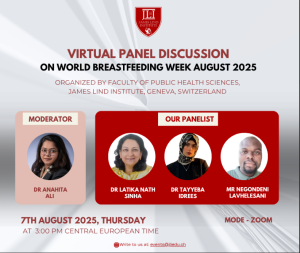
Dr. Anahita Ali, Moderator
Judge for the competition
Mr. Negondeni Lavhelesani, nutritionist, an epidemiologist from South Africa. He has worked in Implementation, Monitoring, and Evaluation of the Integrated Nutrition Program (INP), planned and conducted community-based programs e.g. breastfeeding and growth monitoring support groups, Conducted nutritional assessments and developing intervention strategies, provided nutrition and non-communicable disease training to healthcare professionals.
Panelist names
- Nutritionist – Negondeni Lavhelesani, Lecturer, Public Health, Faculty of Health Sciences, University of Venda, South Africa
- Paediatrician – Dr Latika Nath Sinha, Associate Professor, Medical College Campus, Pali, India
- Public health expert – Dr. Tayyeba Idrees, England, UK
On 2nd August 2025, after the formal welcoming of the participants, guests, and attendees of the competition by the moderator of the event Dr. Anahita Ali, the presenters presented their e-posters one by one with a short oral description of their idea and creation followed by question-and-answer session with the judge. The judge asked 1-2 questions from every participant to understand their concept behind poster design. He also highlighted that the theme of this event is well captured by the presenters in their posters.
Here are the winner names:
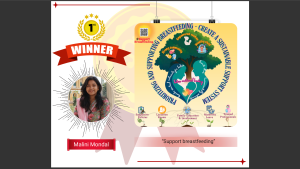
1st – Malini Modal
Malini drew her inspiration from the overlooked, naturalistic details. She underlined that ongoing care and support can contribute to the development of improved child health.
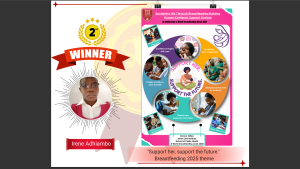
2nd – Irene Adhiambo Odipo
Irene’s e-poster highlights that breastfeeding is never a one-person job and is based on the actual experiences of moms in Africa and beyond. It necessitates a support system that reflects shared accountability. The mother is positioned at the core of the design, but she is surrounded by strong support networks, such as her family, workplace, policy systems, and healthcare providers.
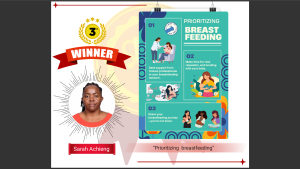
3rd – Sarah Achieng Korwa
The universal need for connection and mental wellness during the breastfeeding journey served as Sarah’s motivation for the design. It seeks to foster a sense of support among moms and other caregivers and normalize asking for assistance. The poster’s main goals are to foster a sense of belonging and give moms support during their breastfeeding journey.
Continuing the celebration, on 7th August 2025, event moderator, Dr Anahita Ali welcomed all the panelist. The discussion initiated with an exploration of the fundamental role of breastfeeding in influencing long-term health outcomes, addressing both mothers and infants. Nutritionist Mr. Negondeni highlights that breastfeeding is crucial as it provides optimal, developmentally tailored nutrition. It significantly enhances the immune system and decreases the likelihood of various health issues like asthma, respiratory infections, obesity, and diabetes. Evidence supports that breastfeeding also fosters cognitive development in infants while contributing to maternal health by lowering risks of breast and ovarian cancers and aiding postpartum recovery.
Further, he emphasizes the importance of implementing public health strategies to support and promote sustainable breastfeeding practices, recommending that national departments establish supportive policies, regulate marketing of breast milk substitutes, and develop culturally sensitive community-based programs. These programs should include peer support networks for mothers to encourage breastfeeding emotionally and physically.
Pediatrician Dr. Ladika is then asked to address the common challenges faced by new mothers in breastfeeding, particularly in countries like India. She identifies a lack of awareness about the importance of breastfeeding among young mothers, compounded by family and cultural influences that may discourage exclusive breastfeeding for the recommended six months. The conversation underscores the necessity for healthcare providers and public health practitioners to support families in overcoming these challenges to ensure successful breastfeeding.
Dr. Tayeeba addresses the importance of public health systems and their role in promoting breastfeeding, particularly in vulnerable populations and underserved areas. She emphasizes that breastfeeding is a mutual benefit for both the infant and the mother, highlighting it as the first food for the baby and a contributor to both mental and social support. She points out misconceptions about the transmission of infections through breastfeeding, asserting that while some infections like HIV and cytomegalovirus (CMV) can be transmitted, many others cannot. She recalls concerns during the COVID-19 pandemic, where mothers were encouraged to continue breastfeeding with proper hygiene precautions, asserting that such practices are essential for the health of both mother and baby. She concludes by stressing the need for educational initiatives to dispel myths and support the bonding experience between mother and child through breastfeeding.
Youtube link: https://www.youtube.com/watch?v=iEgnhu84h60