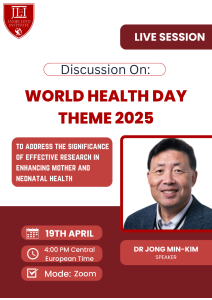
About The Event
Organized by Faculty of Public Health Sciences
James Lind Institute, Geneva, Switzerland
Date: 19th April, 2025
Time: 4:00 PM Central European Time
Venue: Virtual Platform – Zoom
Introduction to the Event
This long year campaign, titled Healthy beginnings, hopeful futures, will urge governments and the health community to ramp up efforts to end preventable maternal and newborn deaths, and to prioritize women’s longer-term health and well-being.
Campaign goals:
- Awareness raising
To raise awareness about gaps in maternal and newborn survival and the need to prioritize women’s longer-term well-being.
- Effective investment
To advocate for effective investments that improve the health of women and babies.
We are committed to advocating for effective, evidence-based investments that significantly improve the health and well-being of women and babies. By prioritizing maternal and infant health, we aim to influence policy, mobilize resources, and support initiatives that address disparities in care, expand access to essential services, and promote long-term health outcomes. Our focus is on ensuring that every woman has access to high-quality prenatal, childbirth, and postpartum care, and that every baby has the best possible start in life. Through collaboration, education, and advocacy, we strive to create lasting change that benefits families and communities for generations to come.
- Encourage support
To encourage collective action to support parents as well as health professionals who provide critical care.
- Provide information
To provide useful health information relating to pregnancy, childbirth, and the postnatal period.
Target Audience
The target audience for this session included early researchers, policymakers, practitioners in the healthcare industry, public health experts, and students from research background.
DETAILS OF THE HOSTS
- Dr. Mufti Suhail Sayeed, Facilitator
- Dr. Anahita Ali, Moderator
Guest Speaker
Dr Jong-Min Kim, Professor of Statistics at University of Minnesota-Morris, USA
After the formal welcoming of the participants, guests, and attendees of the conference by the moderator of the event Dr. Anahita Ali, the guest speaker then took over the session and started with a powerpoint presentation.
Dr Jong stated that enhancing mother and newborn health is recognized as a paramount public health priority that carries significant social and economic implications. Effective research in this domain integrates clinical, behavioral, epidemiological, and health systems approaches to address a range of issues.
according to him, a systematic approach to identifying research priorities is essential. Key areas of focus include maternal mortality and morbidity, where it is important to investigate preventable causes such as hemorrhage, infections, hypertension, and unsafe abortions. Additionally, newborn outcomes warrant attention, particularly concerning issues like preterm birth, low birth weight, neonatal infections, and birth asphyxia.
Data-driven and evidence-based methodologies should be employed for thorough analysis. This includes utilizing large-scale surveys and registries, such as Demographic and Health Surveys (DHS) and Multiple Indicator Cluster Surveys (MICS), along with hospital-based records for longitudinal studies. Advanced technologies, particularly machine learning, can play a critical role in identifying at-risk pregnancies and predicting adverse outcomes.
Testing and scaling interventions represent a vital step in the process. Collaboration among professionals from various fields is crucial. This includes experts in obstetrics and neonatology, public health and epidemiology, nutrition, mental health, social sciences, and data science. Furthermore, leveraging mHealth platforms may facilitate remote monitoring and health education, indicating a transformative approach in health care.
Innovations such as portable diagnostics for early detection of risk factors, AI-driven predictive analytics to identify high-risk pregnancies, and telemedicine services that connect rural communities with specialists, are all part of this integration. Collaborating with ministries of health, NGOs, and international agencies can significantly enhance the effectiveness of medical initiatives.
lastly, a sustained focus on scalability, sustainability, and strengthening health systems is necessary. It is also vital to influence maternal and child health policies through evidence-based approaches to ensure changes are implemented effectively and for long-term benefit.