

About The Event
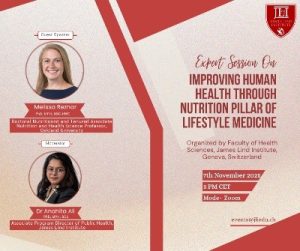
Organized by Faculty of Health Sciences
James Lind Institute, Geneva, Switzerland
Date and Time
7th November 2025 at 3 PM CET
Mode
ONLINE – ZOOM
Introduction to the event
The use of evidence-based lifestyle (LM) interventions to prevent, cure, and even reverse
chronic diseases is the focus of the emerging area of lifestyle medicine. Chronic diseases like
obesity, hypertension, type 2 diabetes, and cardiovascular disease are becoming the world's
major causes of morbidity and mortality, and their prevalence is only increasing. By
encouraging better behaviors, LM offers a potent alternative to traditional medical
practices, which frequently concentrate on pharmacological treatment or symptom
management.
The scientific underpinnings of LM, its six main pillars—sleep, physical activity, nutrition,
stress management, substance avoidance, and social connectedness—and how these
components interact to promote optimal health were all be covered in this session.
In addition to presenting successful case stories of chronic illness prevention and reversal,
the session also highlighted the clinical evidence demonstrating the efficacy of lifestyle
medicine. To enhance patient outcomes, lessen the burden of avoidable diseases, and
encourage sustainable health behaviors, attendees acquired useful, doable solutions that
they may implement in their personal or professional lives. Participants also gained the
knowledge necessary to promote lifestyle medicine as a revolutionary approach to
healthcare by the end of the session.
2
Objectives
1. Describe the six main pillars of LM.
2. Recognize the scientific proof that LM can prevent and reverse chronic illnesses.
3. Determine practical ways to incorporate LM into personal life.
4. Examine a real-world case study that illustrates how lifestyle choices can reverse
disease.
Guest Speaker
Melissa Reznar, PhD, MPH, NBC-HWC, Doctoral nutritionist and tenured associate nutrition
and health science professor, Oakland University in Rochester, Michigan, United States.
Moderator
Dr Anahita Ali, PhD (Public Health), MPH, BDS, Associate Program Director of Public Health,
James Lind Institute, Geneva, Switzerland.
The moderator of the event Dr. Anahita Ali formally welcomed all the participants and guest
speaker. The presentation by Melissa M. Reznar, PhD, MPH, Associate Professor of
Nutrition at Oakland University, introduces Lifestyle Medicine (LM) as a whole-person
approach to preventing and managing chronic disease. It emphasizes nutrition, physical
activity, sleep, stress management, avoidance of risky substance use, behavior change, and
patient engagement rather than focusing solely on treating individual disease risk factors.
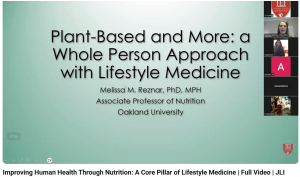
She gave power point presentation titled “Plant-Based and More: a Whole Person Approach
with Lifestyle Medicine”.
1. Chronic Disease and Lifestyle Factors
The presentation begins by highlighting the major burden of chronic disease and associated
healthcare spending. It discusses dietary risks as important contributors to poor health
outcomes and premature mortality. Dietary patterns associated with increased risk include
diets low in fruits, vegetables, legumes, whole grains, nuts and seeds, fibre, seafood
omega-3 fatty acids, polyunsaturated fatty acids, calcium and milk, and high in red and
processed meat, sugar-sweetened beverages, trans fats and sodium.
2. Whole-Food, Plant-Based Diets
A central theme is the role of whole-food, plant-based diets (WFPBDs). These emphasize
minimally processed plant foods such as:
Vegetables
Fruits
Legumes
Whole grains
Seeds
3
Nuts
The presentation discusses evidence linking plant-rich dietary patterns with cardiovascular
health and healthy aging. Higher consumption of fruits, vegetables, whole grains,
unsaturated fats, nuts, legumes and low-fat dairy products was associated with greater odds
of healthy aging, while higher consumption of trans fats, sodium, sugary beverages, and red
or processed meats was inversely associated with healthy aging.
It also notes that increasing whole plant foods while reducing the animal-based component
of traditional Mediterranean-style diets may potentially provide additional health and
sustainability benefits.
3. What Is Lifestyle Medicine?
The presentation also emphasizes that Lifestyle Medicine recognizes the relationship
between health behaviors and health outcomes and incorporates behavioral science to
support sustainable change. Physicians may prescribe lifestyle interventions, while other
healthcare professionals can provide complementary support.
4. Lifestyle Medicine vs. Traditional Medicine
The presentation contrasts conventional approaches with Lifestyle Medicine. Traditional
medicine is described as often focusing on individual risk factors, with patients receiving
solutions from healthcare professionals. Lifestyle Medicine instead focuses on the whole
patient and their lifestyle, considers patients active partners in their care, and aims for
meaningful long-term lifestyle changes.
5. Evidence: Diabetes Prevention Program
The Diabetes Prevention Program (DPP) is presented as an important example of lifestyle
intervention. The landmark NIH-funded study, published in 2002, included 3,234 adults
without diabetes who had elevated glucose levels. Participants were randomly assigned to
placebo, metformin, or lifestyle intervention groups.
The lifestyle intervention included a goal of losing 7% of initial body weight, following a
low-calorie, low-fat diet, achieving 150 minutes of moderate-intensity physical activity per
week, and completing a structured 16-lesson curriculum addressing diet, exercise and
behavioral modification. The intervention was flexible and individualized and included
subsequent individual and group sessions.
6. Coaching and Behavior Change
An important component of Lifestyle Medicine is health and wellness coaching. The
presentation contrasts an “expert-like” approach with a “coach-like” approach. Rather than
simply providing answers and advice, coaching helps individuals develop motivation,
confidence, engagement, self-awareness and personal solutions. It emphasizes
collaboration and identifying what is already working.
4
Behavior change is recognized as complex. It is influenced by individual preferences,
motivations and barriers, stage of change, counseling style, social norms, support systems
and community influences.
7. Lifestyle Medicine in Healthcare
The presentation discusses implementing Lifestyle Medicine and whole-food, plant-based
dietary approaches within healthcare systems. Preliminary findings highlighted several
potentially important components, including supportive administration, shared medical
appointments, multidisciplinary teams of passionate clinicians, and employee pilot
programs.
8. Nutritional Considerations and Practical Application
The presentation also considers nutrient intake among people following plant-based diets
and references evidence comparing nutrient status between plant-based diet consumers
and meat-eaters.
Practical implementation emphasizes making healthy behaviors easier, taking small steps
(“baby steps”), and using social support to facilitate sustainable lifestyle change.
Overall the presentation promotes Lifestyle Medicine as a whole-person, preventive and
behavior-focused approach to chronic disease management. Its central message is that
health improvement extends beyond medications and treatment of symptoms.
Nutrition—particularly minimally processed, plant-rich foods—combined with physical
activity, sleep, stress management, behavioral support and patient engagement can form an
integrated approach to improving health and supporting long-term behavior change.
Access the full event recording on our YouTube channel at
